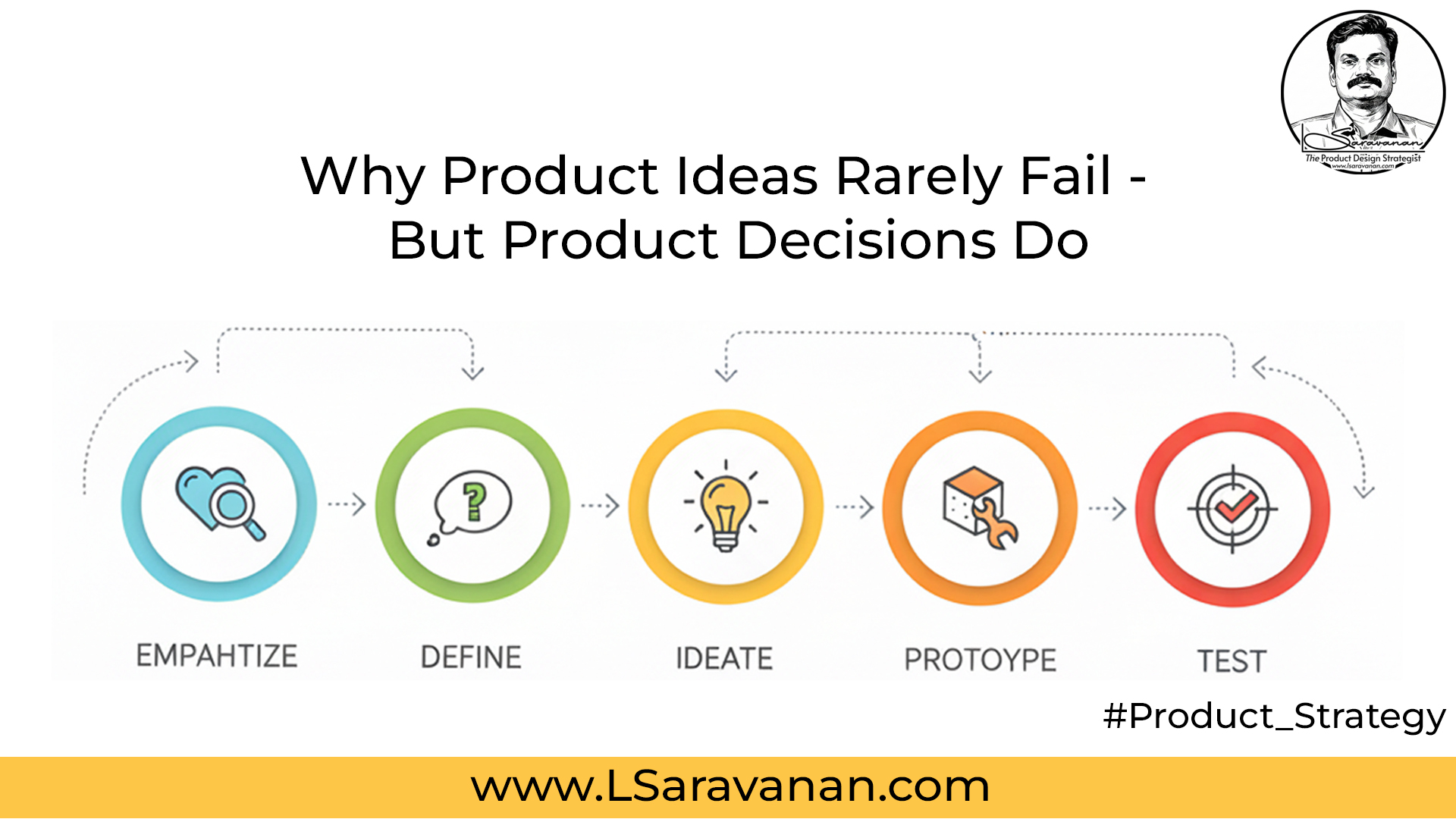
Physical products rarely fail because the idea was wrong. They fail because of the decisions made around the idea — who it’s for, what problem it solves, and what gets traded away — most of which are made by default rather than by design. Fixable ideas are abundant; disciplined decisions are rare.
There is a story almost every hardware founder tells themselves after a product launch stalls: “The idea was ahead of its time.”
It’s a comforting narrative. It protects the ego and preserves the belief that the vision was sound—the world just wasn’t ready. But after nearly two decades of working with teams building physical products, I’ve come to a different conclusion.
The idea was rarely the problem. The decisions surrounding it were.
This distinction is the difference between a hobby and a business. If you believe your idea failed, you’ll go looking for a better idea. If you understand that your decisions failed, you’ll start building a better decision-making process. That process is what I do as a product decision strategist.
The Weightlessness of Ideas
Ideas are abundant. On any given week, a founder describes a concept that is genuinely compelling: a smarter agricultural tool, a more ergonomic medical device, or a cleaner energy solution for emerging markets.
But an idea, in isolation, is weightless. It costs nothing to harbor and carries no inherent risk. Risk only enters the room the moment you start making decisions about that idea.
- Which user are you designing for—the one you imagined, or the one who exists?
- What problem are you solving—the one you assumed, or the one you validated?
- What does “ready” mean—a prototype that works in a lab, or a design that survives the real world?
These are decision points. Most founders pass through them without realizing they’ve made a choice at all.
Failure by Default
In physical product development, there is a common, dangerous pattern. A founder has a strong idea and moves quickly. Sketches become CAD files; CAD files become 3D prints; 3D prints lead to tooling conversations. This momentum feels like progress.
But in that rush, critical decisions are often made by default rather than by design.
Consider the development of a portable water purification device. The idea is sound; the market need is documented. However, failure often hides in the “defaults”:
- Technical Default: Choosing a filter technology because it’s familiar, not because it fits the user’s environment.
- Financial Default: Setting a price point based on internal cost structures rather than the user’s actual purchasing power.
- Form Factor Default: Designing for what looks good in a pitch deck rather than how the product is stored and used in a cramped household.
None of these are conscious choices. They are assumptions that hardened into “facts” without ever being interrogated. By the time the product reaches the pilot phase, the gap between what was built and what was needed is too wide to bridge.
The Liability of Speed
Founders are often trained to “move fast and break things.” In software, this is a virtue; you can patch a bug in an hour. In hardware, speed without strategic clarity is a liability.
You cannot push an over-the-air update to a steel injection mold. You cannot A/B test a high-volume tooling decision. Every unexamined assumption that survives into production becomes a compounding cost. This is exactly why tooling is not progress — it locks the decision in.
The decisions that matter most are made when the product is still a hypothesis. These early choices set the trajectory. By the time a mistake is realized, the cost of reversing it is often terminal for the project.
Great products are decided long before production begins.
The Three Pillars of Product Fate
To avoid failure by default, founders must master three specific categories of decision-making:
1. The User Decision: Specificity Over Demographics
“Urban professionals aged 25–40” is a census category, not a user. A real user decision identifies a specific person, in a specific context, with a specific frustration. When this decision is precise, every design choice has a reference point. When it is vague, every design choice is a guess.
2. The Problem Decision: Urgency Over Reality
There is a difference between a problem that is real and a problem that is urgent enough to trigger a change in behavior. Physical products require users to buy, adopt, and integrate something new into their lives. If the problem definition doesn’t evolve as you learn, you will arrive at production with a solution for a problem that no longer exists—or never mattered enough to solve.
3. The Constraint Decision: The Art of Sacrifice
Every physical product is a negotiation between cost, performance, durability, and aesthetics. Successful founders make the hierarchy of these constraints explicit early on. They decide what they will optimize for and what they will trade away. Those who try to optimize for everything end up with a product that is mediocre, expensive, and late.
A Framework for Not Starting Over
Shifting from “Idea Thinking” to “Decision Thinking” is uncomfortable. It requires slowing down at the moments when the instinct is to accelerate.
It means:
- Building a Decision Log before you build a prototype.
- Documenting the Assumptions that underpin every technical choice.
- Creating Checkpoints to test those assumptions against reality before committing to tooling.
This is precisely what the LSAR decision framework — Listen, Structure, Analyse, Resolve — is built to enforce.
The Reframe
If you have ever launched a product that didn’t land, the idea was likely not the culprit. The gap opened up in the decisions you made—some consciously, many by default.
This is good news. Decisions can be improved with process. The founders who build iconic physical products are not necessarily those with the “best” ideas; they are the ones who have learned to make better decisions—earlier, more deliberately, and with a clearer understanding of the stakes.
Many founders fall into what I call the Solution Trap — jumping to a product before fully understanding the problem. But even when the problem is real, products still fail if the decisions surrounding them are weak. Read more in The Solution Trap: A Risky Product Development Strategy.
Frequently Asked Questions
If my product failed, how do I know it was the decisions and not the idea?
Look at the choices made before production: who you designed for, what problem you assumed, and what constraints you traded away. If those were made by default — never written down, never tested — the failure is almost always in the decisions, not the idea itself.
What is a “decision made by default”?
It’s an assumption that hardened into a “fact” without ever being interrogated — choosing a familiar technology, pricing from internal cost, or designing for a pitch deck instead of real use. It feels like momentum, but it’s an unexamined choice setting an irreversible trajectory.
How do I make decisions “by design” instead?
Keep a decision log and an assumptions list before you prototype, and build checkpoints to test those assumptions against reality before you commit to tooling. Master the three pillars — user, problem, and constraint decisions. If you want an outside read before a build decision, talk to L Saravanan.
Before your next decision becomes an irreversible production cost, let’s pressure-test your assumptions. Bring your concept; leave with clarity on the decisions that will define it.
Talk to L Saravanan →