
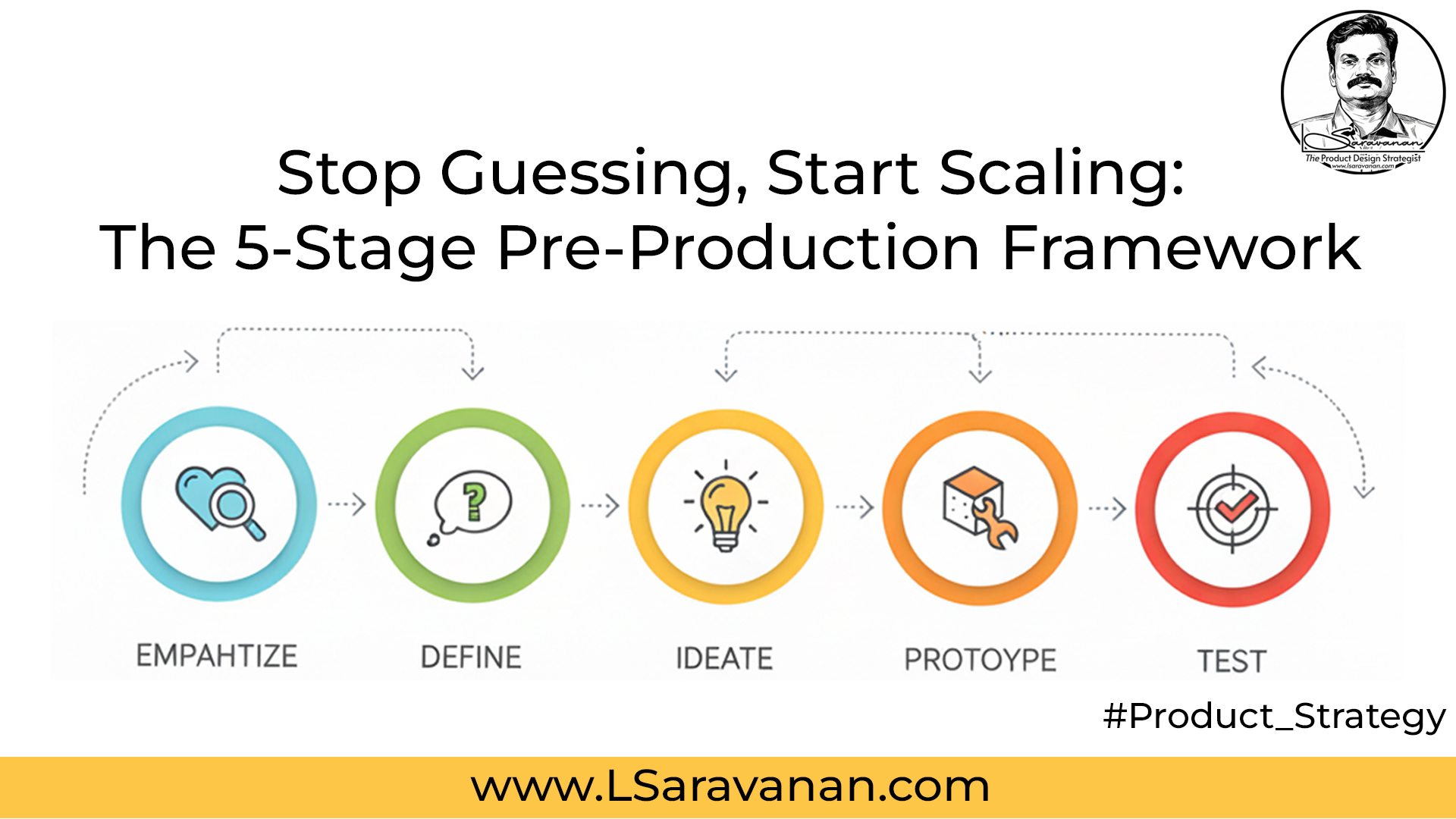
Stop Guessing, Start Scaling: The 5-Stage Pre-Production Framework
Pre-Production Validation Framework
In my years as a Product Design Strategist, I’ve realized one uncomfortable truth: most product failures are not design failures; they are validation failures.
In the rush to see a physical product on a retail shelf or a machine on a factory floor, I see founders treat “tooling” as the finish line. In reality, tooling is a massive financial magnifying glass. If we have built a precise solution for a validated need, tooling magnifies our success. But if our market assumptions are off by even 10%, that same tooling magnifies our losses, our inventory bloat, and our capital waste.
I tell my clients that the most expensive mistake you can make isn’t a bad prototype—it’s a perfect production run of a product nobody wants. This Pre-Production Validation Framework is the insurance policy I use. It integrates market clarity, engineering feasibility, and capital discipline long before we sign the cheque for a mold or a production line.
The Philosophy of “Clarity Before Commitment”
Before we dive into the stages, we need to shift our mindset. In the world of industrial design and product strategy, there is a dangerous temptation to fall in love with the “object.” We focus on the curve of the casing, the premium feel of the finish, or the slickness of the interface. While these matter, they are secondary to the Utility/Context Fit.
My approach to strategic discipline requires us to be “problem-first,” not “solution-first.” This framework is designed to force that discipline upon the development process. We move from the abstract (the problem) to the concrete (the capital), ensuring that by the time you reach Stage 5, your move into manufacturing is a calculated execution, not a leap of faith.
Stage 1: Problem Validation (The Root of Risk)
Before I let a client touch a CAD model, before we select a material palette, and certainly before we think about branding, we must validate the “why.”
The Anatomy of a Validated Problem
A problem is only worth solving if it meets three criteria: it is Frequent, it is Painful, and it is Expensive.
- Who exactly experiences this pain? We cannot solve a problem for “everyone.” We need a specific persona. In Indian industrial environments, is it the floor operator dealing with heat, the maintenance lead, or the procurement officer looking at the bottom line? In consumer markets, is it the urban professional or the rural entrepreneur?
- Is the pain urgent or optional? Many products solve “mild inconveniences.” In my experience, mild inconveniences do not drive high-margin sales in a price-sensitive market like India. We are looking for “hair-on-fire” problems—issues that stop production lines or cause significant emotional or financial distress.
- What is the “Cost of Inaction”? If a factory loses ₹4,00,000 for every hour of downtime, a ₹80,000 solution is a “no-brainer.” If a consumer spends ₹4,000 a month on temporary fixes, a ₹15,000 permanent tool is an easy sell.
Example: The Industrial Sensor Realignment
I once looked at a concept for an industrial sensor that tracked machine vibrations. The initial idea was to sell a high-tech vibration monitor. However, through observation, I found that machines didn’t just “break”; they degraded over three weeks. The real problem wasn’t the vibration—it’s that the maintenance teams didn’t have a predictive schedule. We shifted the entire strategy from a “vibration sensor” to a “Predictive Maintenance Dashboard.” By validating the problem, we saved lakhs in useless hardware development.
Stage 2: User and Context Clarity
It is remarkably easy to validate an opinion in a focus group or a boardroom. It is incredibly difficult to validate a context in the real world. Products often fail because they are designed for a “perfect environment” that simply doesn’t exist.
Environmental Constraints
I advocate for “Ethnographic Research”—watching the user in their natural habitat.
- Physical Constraints: Will the product fit on a standard Indian industrial rack? Does it require two hands to operate when the user usually only has one free because they are holding a handheld terminal?
- Maintenance & Durability: Does the product require a clean room, or will it be covered in dust, humidity, and grease? If it’s a consumer product, does it survive the voltage fluctuations common in many regions, or a drop on a hard stone floor?
The Social & Emotional Context
Context isn’t just physical; it’s psychological. In a corporate setting, a product might fail because it makes the operator look incompetent or adds three extra steps to their already exhausted day. In a consumer setting, a product might fail because it doesn’t fit the “social status” or aesthetic of the Indian home, regardless of how well it functions.
Case Study: The “Smart” Kitchen Appliance in India Many smart appliances fail here because they ignore the context of time and help. A user doesn’t want to navigate a 5-step digital menu when they are trying to cook while managing a household. If the context validation reveals that physical knobs are superior to touchscreens for oily or wet hands, that is an engineering decision that must be made before tooling.
Stage 3: Market Positioning Alignment
Validation is incomplete without a clear strategy on how you will compete. You must define your territory before you manufacture your army.
Functional vs. Emotional Differentiation
- Functional: Your product does something others can’t (e.g., it’s 30% more energy-efficient).
- Structural: Your product fits into an Indian ecosystem others can’t (e.g., it works with local power standards or existing machinery).
- Emotional/Brand: Your product represents an identity.
The Pricing Trap
One of the biggest pre-production mistakes I see is setting a price based on “Cost Plus” (Cost + Margin = Price). In my practice, I push for “Value-Based” pricing. We must validate if the market perceives enough value to pay a price that allows for a healthy margin.
If your manufacturing cost is ₹4,000 and the market only perceives ₹5,000 of value, you have a “Margin Collapse” risk. I wouldn’t advise tooling up for a product with a 10% margin in a volatile economy; you’ll be out of business before your second production run if raw material costs spike.
Stage 4: Engineering & Production Feasibility
This is where “Design for Manufacturing” (DFM) meets “Strategic Sourcing.” Market demand is irrelevant if we cannot build the product profitably at scale.
The Complexity/Cost Ratio
Every additional part in your assembly is a point of failure and a cost centre. Validation here means:
- Tooling Complexity: Can this be made with a single-cavity mold, or do we need complex slides and lifters that drive up the initial investment by lakhs?
- Material Sourcing: Is that specific polymer available in 10-ton quantities locally, or are we reliant on expensive imports with fluctuating customs duties?
- Regulatory Compliance: Have we accounted for BIS (Bureau of Indian Standards) or other industry-specific certifications? Trying to retro-fit a design for compliance after the molds are cut is a financial nightmare.
Scalability Analysis
I always ask my clients: “What happens if we succeed?” If we sell 10,000 units instead of 1,000, does the supply chain break? Conversely, if we only sell 500, can the business survive the “Low Volume” unit cost?
Stage 5: Capital Readiness Check (The Discipline Stage)
This is the final gate. Stage 5 is not about design; it is about the “Math of Survival.” Before you pay for tooling, we conduct a cold-blooded financial review.
Testing Assumptions
We list every assumption made so far:
- “We assume users will pay ₹14,999.” (Have we taken a single pre-order or deposit?)
- “We assume the lead time is 45 days.” (Is that in a signed contract from the vendor?)
- “We assume a 3% defect rate.” (What happens to our cash flow if it’s 10%?)
The Break-Even Reality
I help founders model their “Worst-Case Scenario.” If demand is 50% of your projection, does your company survive? Many founders use “Optimism Bias” to justify tooling. As a strategist, I use Financial Resilience. You should only move to production when the data—not your gut—says you are ready.
Common Mistakes I See in Pre-Production Validation
Even seasoned founders fall into these traps:
- Over-Engineering Early Concepts: Adding “bells and whistles” to solve problems you haven’t even confirmed exist.
- The “Uncle/Friend” Bias: Seeking feedback from people who love you instead of people who will actually pay you.
- Ignoring Logistics: Designing a product that is 5cm too wide to fit efficiently on a standard shipping pallet, which can increase your logistics costs by 20% overnight.
- Scaling on Confidence, Not Evidence: Feeling “sure” it will sell because the 3D render looks “world-class.”
The Checklist: Are You Ready for Tooling?
If you cannot check all seven of these, I will tell you that you are not ready for manufacturing:
- [ ] Segmented User Profile: You can describe your target user’s daily struggle.
- [ ] Quantified Pain: You know exactly how much money your user loses without your product.
- [ ] Context-Tested Prototypes: Your prototypes have survived a week in the actual environment of use.
- [ ] Positioning Map: You know exactly which competitor you are displacing and why.
- [ ] Final DFM Review: The manufacturer has signed off on the technical drawings.
- [ ] Margin Resilience: You have modeled profits at 50% and 150% of projected volume.
- [ ] Verified Demand: You have actual “skin in the game” signals from potential buyers.
Strategic Reflection
In my studio, I often tell founders that “the first version is for learning.” When we are sketching on an iPad or watching a 3D printer layer resin in the lab, that mindset is essential. It’s where we have the freedom to fail, iterate, and break things. But as a strategist, I have to be the voice of reality: Once you move from the lab to steel molds and assembly lines, the “learning” becomes incredibly expensive.
At that stage, an oversight isn’t just a “learning curve”—it’s a massive hit to your capital and your timeline.
The Pre-Production Validation Framework isn’t a set of brakes designed to slow your ambition; it is a high-performance engine designed to ensure that when you finally hit the gas, you are heading in the right direction. For me, “Clarity Before Commitment” isn’t just a design philosophy—it is the only way to build a resilient, profitable, and impactful brand in today’s market.
Stop guessing. Start validating. Protect your capital, and let’s build something that actually matters.
FAQ: Pre-Production Validation
Q: How long does this framework take to implement? A: Depending on the complexity, Stages 1-3 can take 4-8 weeks. Stages 4-5 often run parallel to final engineering. It’s better to lose two months in validation than two years in a failed launch.
Q: Is validation expensive? A: It is significantly cheaper than a ₹5,00,000 tooling error or ₹10,00,000 in unsellable inventory. I view validation as an investment in risk reduction, not an expense.
Q: When is the right time to call a strategist like me? A: The best time is at the “Problem” stage. The second best time is before you pay your manufacturing deposit.
Final Note from L. Saravanan
In physical product development, production is not just a milestone — it is a capital decision.
I work with founders and product teams at the stage where validation, positioning, engineering feasibility, and margin logic must align before manufacturing begins. Structured clarity at this point prevents expensive misalignment later.
If you are preparing to move from prototype to production and want disciplined, strategic alignment before committing capital, a Product Strategy Review can help you move forward with confidence and precision.
Learn more at lsaravanan.com when you’re ready to build with clarity.
No responses yet