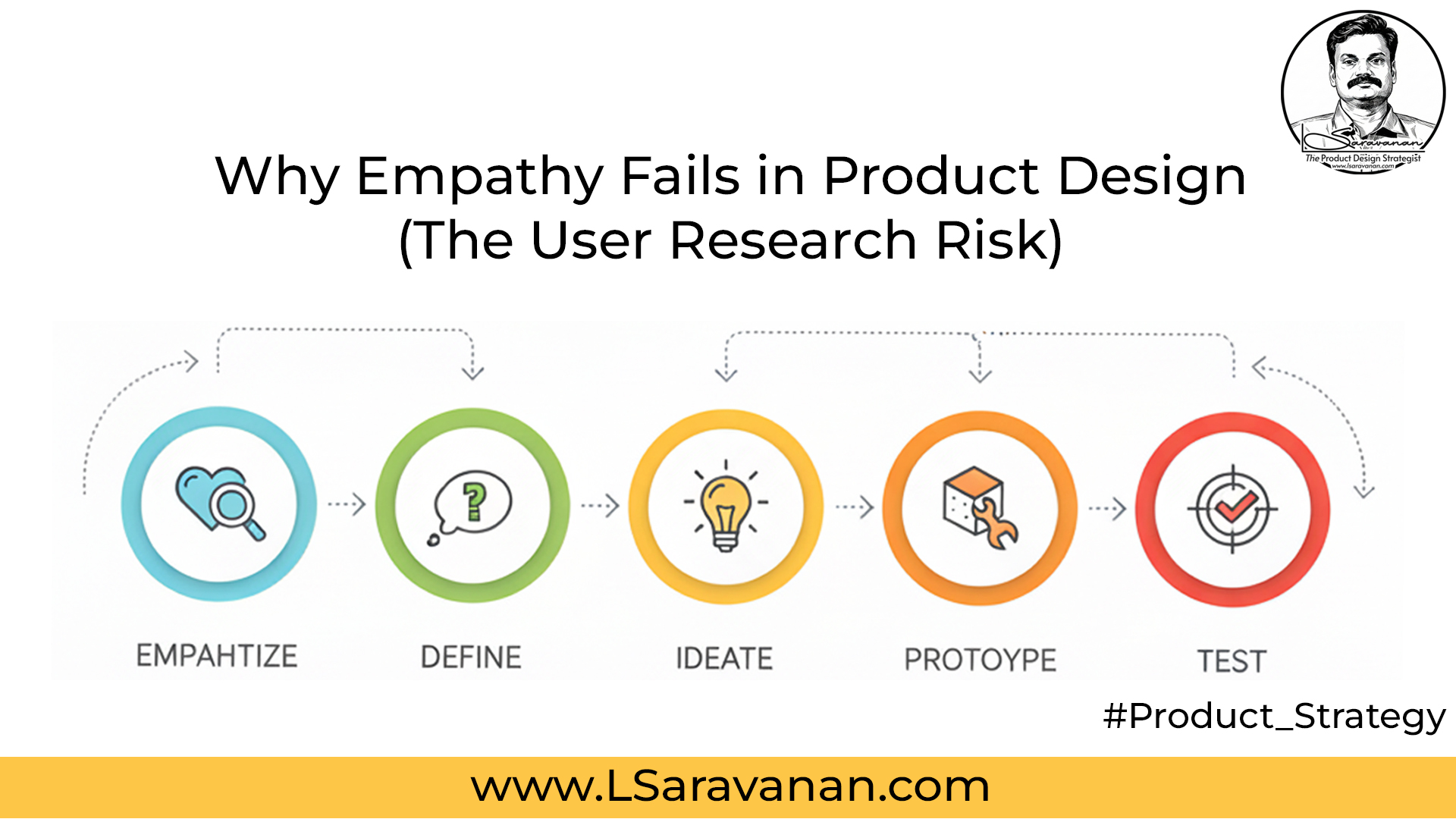
Why Empathy Fails in Product Design (The User Research Risk)
Empathy in product design fails when emotional assumption replaces structured behavioral validation. Teams often mistake “feeling” a user’s pain for a validated business insight, leading to products that resonate in interviews but collapse in the market. In physical manufacturing, this isn’t just a design flaw—it’s a capital mistake that locks unverified assumptions into expensive tooling and dead inventory.
Good morning. If you’ve spent any time in design workshops lately, you’ve heard the word “Empathy” a thousand times. We run empathy maps, we “feel” the user’s journey, and we build pitch decks around “deep understanding.”
I’m here to tell you that empathy is a starting posture, not a research methodology.
At lsaravanan.com, I see founders fall into this trap constantly. They care so much about the user’s frustration that they stop asking if the user is actually willing to pay to fix it. Empathy opens the door to curiosity, but it doesn’t tell you the price point, the manufacturing constraints, or the unit economics. Confusing “caring” with “insight” is how you end up with a well-designed product that is just an expensive experiment.
The Reality: Users are Unreliable Narrators
You can feel exactly what a user feels and still be 100% wrong about what they need.
- They say they want simplicity; they buy features.
- They say they want speed; they tolerate friction for status.
- They say they’ll pay for it; they won’t.
Real research is about pattern recognition across behavior, context, and consequence—not just conversation. For a physical product, this gap is unforgiving. If your empathy-driven redesign increases unit cost by 18% and requires a new $40,000 injection mold, you haven’t solved a problem. You’ve created a financial liability.
Real-World Friction: The “One-Tap” Failure
I once observed a startup spend eight months on a smart home device. Their empathy research was “perfect.” Users hated complicated setups. The team felt that pain and designed a gorgeous, minimal device with a one-tap setup.
The catch? That “simple” experience required proprietary firmware and a custom chip that pushed the manufacturing cost to $94 per unit. To maintain a margin, the retail price had to hit $149. The market average was $49.
The empathy was real, but the insight was incomplete. They understood the emotion but ignored the price sensitivity and manufacturing reality. They wrote off the entire tooling investment and delayed their launch by 14 months to redesign. Tooling doesn’t iterate; it punishes unvalidated empathy.
Where the Research Breaks: A Systematic View
Using a systematic approach, we identify four ways empathy-led design fails the business model:
1. Empathy Maps Replace Behavioral Data
Teams spend hours mapping “feelings” but zero hours observing actual usage. A map is a hypothesis; documented behavior is a fact. Empathy maps are for generating questions, not providing answers.
2. Stated Preference vs. Purchase Intent
When a user says, “Yes, I would use that,” they are being socially polite. In research, “I would use it” is noise. “I am currently paying X to solve this” is a signal.
3. Prototype Possibility vs. Profitability
A 3D-printed prototype that users respond to emotionally proves the concept can exist. It does not prove the supply chain is viable or the customer will pay the required premium. Prototype proves possibility, not profitability.
4. The Vocal Minority Trap
The loudest users in your research sessions usually want more features. Your most profitable users usually want better outcomes. If you empathize only with the vocal, you over-build for the few and alienate the many.
Strategy Q&A (User Research Audit)
Q: What is the difference between empathy and user research? A: Empathy is a mindset that reduces bias and opens curiosity. User research is a methodology that validates behavioral data. Empathy tells you how they feel; research tells you what they will actually do and what they will pay for.
Q: Why is “stated preference” dangerous in manufacturing? A: Because manufacturing requires upfront capital for tooling and MOQs. If you build based on what people say they want rather than what they do, you risk locking a false assumption into a $50,000 mold that cannot be easily changed.
Q: How do you validate empathy before committing to production? A: Move from interviews to “Constraint Mapping.” Test the price ceiling, the environment of use (dust, light, gloves), and the switching cost. If the user isn’t willing to change their current behavior, your empathy has no commercial value.
The Bottom Line: Empathy Without Constraint is Fantasy
Strategy is about making choices under pressure. Design is about solving problems within constraints. If your research doesn’t include budget, manufacturing, and workflow constraints, it isn’t research—it’s storytelling.
In SaaS, a bad empathy-led decision costs a sprint. In manufacturing, it costs a production run and a supplier relationship. The stakes are not equal, but the mistake is the same.
Don’t just feel the problem. Validate the solution before you fund it.