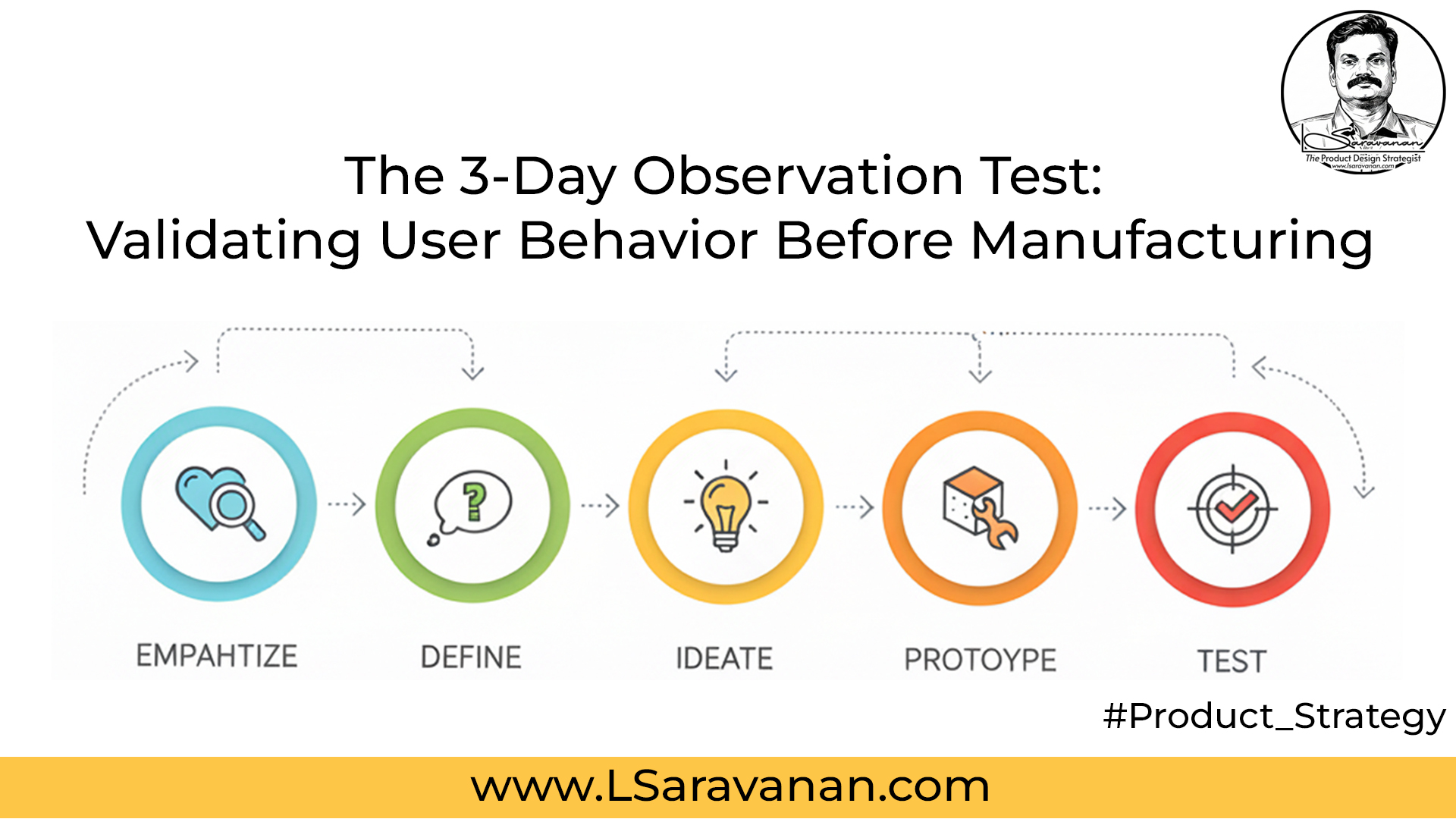
The 3-Day Observation Test is a structured behavioral validation method that uncovers real-world friction by watching users in their natural environment without asking a single question. It ensures that product decisions are built on revealed behavior rather than stated preference—protecting your capital from the expensive “Performance Gap” inherent in traditional user interviews.
There is a specific kind of confidence that comes from a completed research deck. You have your interview transcripts, your affinity maps, and a persona named Priya with a backstory, a pain point, and a preferred communication style.
I’m here to tell you that Priya is a fiction, and building a physical product based on her is a massive capital risk.
In my work as a product decision strategist, this kind of observation belongs to the Listen phase of the LSAR framework — where you see reality before you structure or analyse anything. The most expensive mistake I see repeatedly is not a “bad design”—it’s a product built on what users said they wanted, rather than what their behavior actually demanded. The gap between those two is where ₹15 to ₹25 Lakhs quietly disappears into unusable tooling and dead inventory.
“Users don’t behave in interviews. They perform.”
The Reality: Users Are Unreliable Narrators of Their Own Behavior
When a user sits in a quiet room for an interview, they are being helpful. They give you the answer that sounds most reasonable. What they don’t do is show you how they actually behave when they are rushed, distracted, or covered in grease on a workshop floor.
Empathy without context is just an assumption. Observational research—specifically ethnographic study in the user’s actual environment—bypasses this structural limitation entirely. You are not asking; you are watching. And what you see is almost always different from what you were told. (This is the same gap behind why user interviews mislead founders.)
Real-World Friction: The Founder Who Listened Too Well
I recently analyzed a case involving a founder building a storage solution for workshop owners. She ran twelve interviews. Every participant said the same thing: they needed “quick and easy access.” She took that feedback at face value and designed a clean, minimal, fast-opening product.
Six months after launch, returns were climbing. The feedback? The product felt “flimsy.”
What happened? In the interview, users were reacting to a concept. But in the real workshop, hands were covered in grease, people were working under time pressure, and they were grabbing tools with force. The “easy access” they asked for in the interview was secondary to the durability they required in behavior. Because no one watched them struggle in their actual environment, the mistake was locked in metal before the first unit shipped.
Tooling locks mistakes into cost.
The 3-Day Observation Test: A Systematic Approach
This is a low-cost, high-leverage method to see reality before you commit capital to manufacturing. It requires zero questions—only disciplined silence.
- Day 1: Environment Mapping: Map the context. Do not look for problems yet. Document the worn paths on the floor, the sticky notes on machines, and the workarounds users have “normalized.” These are behavioral signals no interview will ever surface.
- Day 2: Friction Observation: Introduce a task related to your product’s purpose. Do not explain. Do not guide. Watch for the moment they abandon the “intended path” and find their own. Friction is revealed preference.
- Day 3: Pattern Validation: Repeat with a different user. You are looking for patterns. If the same friction point appears twice independently, that is a signal worth designing for. If not, it’s an outlier.
The Point of No Return
In the LSAR framework, observation belongs to the Listen phase — the financial gatekeeper that comes before you commit anything to metal. Once you move into production:
- Observations become design decisions.
- Design decisions become tooling.
- Tooling becomes inventory.
At this stage, misunderstanding behavior is no longer a research error; it is a financial loss. If you haven’t watched your user struggle in their actual environment, you are ready to observe—not to commit capital.
Inventory does not pivot. Tooling does not iterate.
The Bottom Line: Observation as a Financial Control
User observation is not a “phase” you can skip; it is the activity that determines whether your capital investment will return value or become a write-off. The cost of three days of watching is a fraction of the cost of a single tooling revision.
Where assumptions become capital, decisions become inventory. Watch the struggle before you commit the capital. Because once your assumptions become tooling, correction is no longer iteration—it is cost. You can see this discipline applied end-to-end in a real product decision case study.
Frequently Asked Questions
Why is observation better than user interviews for product validation?
Interviews capture stated preference (what people say), while observation captures revealed behavior (what people do). In high-stakes manufacturing, behavior is the only data that accurately predicts whether a design will survive real-world use.
What is “normalized friction” in user research?
These are pain points users have lived with for so long that they stop noticing them. They won’t mention them in an interview, but they are often the most valuable design opportunities for a new product.
What is the difference between user feedback and user behavior?
User feedback is a post-rationalized narrative. User behavior is raw, unfiltered action under real-world constraints. Strategy must prioritize behavior to ensure the product solves the actual problem, not the described one. If you’re about to finalize a design or commission tooling, talk to L Saravanan first.
Before you finalize your design or commission tooling, let’s assess your decision readiness — and whether you’ve actually seen the behavior your product depends on. Start with a focused 15-minute decision call.
Talk to L Saravanan →