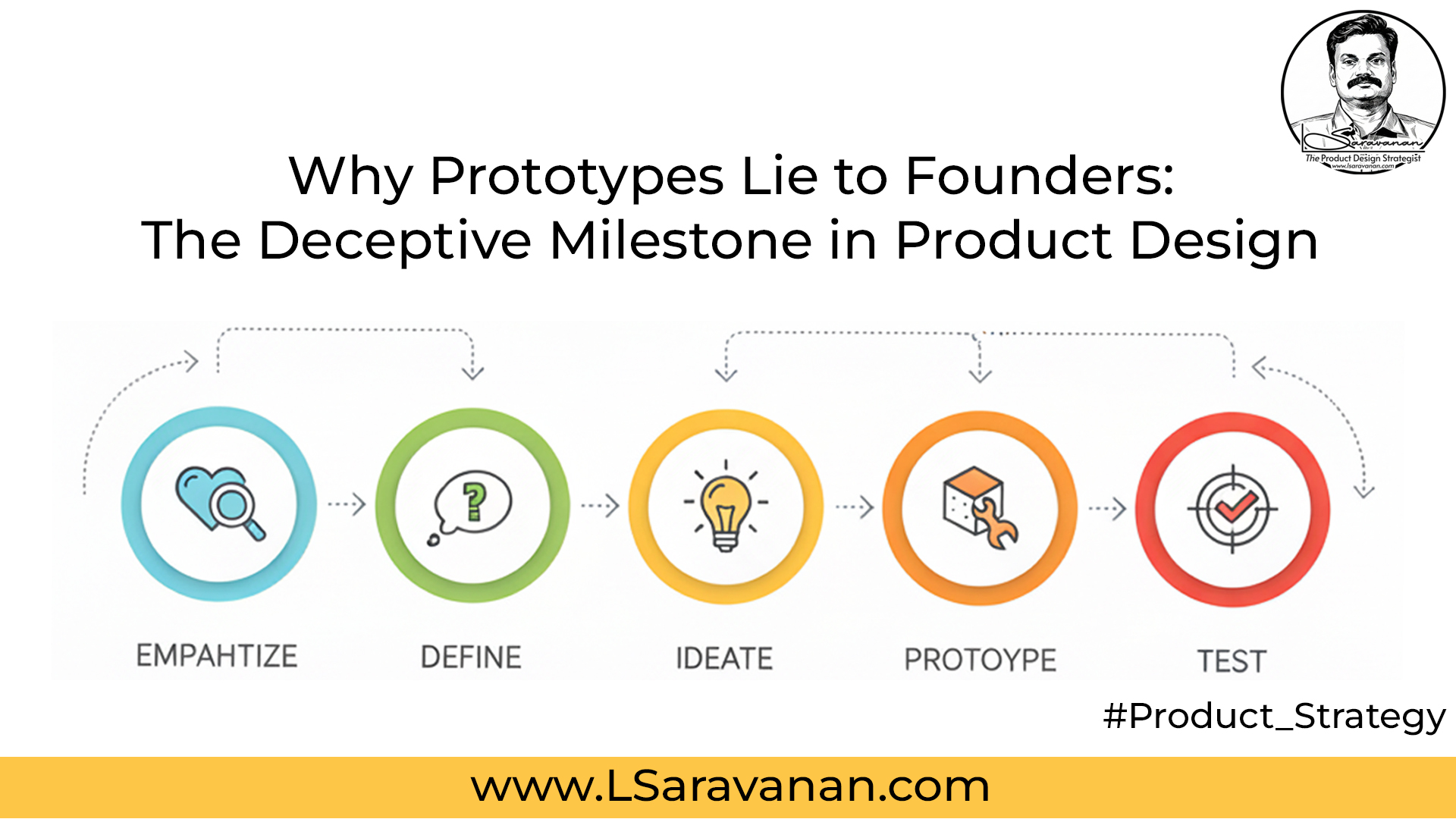
A prototype proves a product can be built. It does not prove the product can be manufactured at scale, survive the real world, or sell at a profit. Treating a working prototype as proof of readiness is the most expensive misread in hardware development.
The first time you hold a working prototype, you are in immediate danger.
After months of theoretical debates, sketches, and CAD iterations, the idea finally has physical mass. It moves, it glows, it functions. To a founder, this is the ultimate “Aha!” moment. Investors are nodding, the team is celebrating, and the path to market looks like a straight line.
But as a product decision strategist, I see something different. I see the onset of “Prototype Euphoria.”
This is a psychological state where the tangible success of a one-off model masks the brutal complexities of industrial reality. It is a state of mind where “it works” is mistaken for “it’s ready.”
The truth is simple: A prototype proves that something can be built. It does not prove it can be manufactured, scaled, or sold at a profit.
Understanding “Prototype Euphoria”
Prototype Euphoria is the most common cognitive bias in the hardware and product world. It occurs when the relief of seeing a functional concept blinds the decision-maker to the “valley of death” that lies between the lab and the consumer’s hand.
In this state, founders begin to treat the prototype as a finished product rather than a research tool. They stop asking “What could go wrong?” and start asking “When can we ship?” This shift in mindset is where lakhs of rupees are lost to premature tooling and unfixable design flaws.
Why “Hero Units” Create False Confidence
Founders and VCs often fall into the trap of believing that a functional prototype is 90% of the way to a finished product. In reality, you are likely only at the 30% mark.
- The “Hero Unit” Bias: Your prototype was built by elite engineers using high-end 3D resins and hand-soldered boards. It is a hand-crafted masterpiece. Production, however, is a chemistry and physics project where thousands of units must be identical.
- The Feedback Mirage: Early testers are socially conditioned to be supportive. “This is cool” is a polite social cue; it is not market validation. Real validation only happens when a customer is willing to part with capital in a competitive environment.
- The Sunk Cost Blindspot: You’ve invested too much to see the flaws. You seek confirmation that the design works, rather than looking for the reasons it will fail.
The Three Strategic Lies of the Prototype
To move from a design studio to a global market, we must dismantle three core myths that lead to “The Prototype Trap.”
1. “If it works in the lab, it works on the line.”
A prototype is built with flexibility; production is built with rigid constraints.
- The Reality: Can 10,000 units maintain a 0.05mm tolerance without a human “tweaking” them?
- The Risk: What works in a controlled environment often shatters when subjected to the heat, speed, and material drift of a high-volume factory line. In production, a 1% failure rate is a crisis. In prototyping, it’s invisible.
2. “Manufacturing is a finishing step.”
This is the most expensive assumption in product development.
- The Reality: Manufacturing is a fundamental design constraint. If you haven’t integrated Design for Manufacturing (DFM) now, the factory won’t “solve” your flaws—they will charge you to redesign the product from scratch while your launch window closes.
- The Risk: Manufacturing does not fix design flaws; it scales them at an exponential cost.
3. “Enthusiasm equals market demand.”
Interest is not intent.
- The Reality: A prototype proves you have an interesting object; it doesn’t prove you have a viable business model.
- The Risk: Founders often mistake curiosity for “Product-Market Fit.” Curiosity is free; market fit is expensive. (More on this in Interest vs. Intent.)
The “False Summit” and Its Consequences
When a prototype functions, it creates a “false summit” that leads to irreversible, premature decisions:
- Premature Tooling: Sinking ₹40 lakh into steel molds before the design is validated for assembly. Once the steel is cut, your design is locked in—errors and all.
- Aggressive Marketing: Setting launch dates based on a “working model,” creating a ticking clock that forces fatal quality compromises during the scaling phase.
- Inflated Valuations: Raising capital based on a “milestone” that hasn’t actually de-risked the scalability of the business. This creates a debt of expectation that many startups cannot repay.
The Founder’s Reality Check
| Feature | The Prototype (The Lie) | The Product (The Reality) |
| Build Method | 3D Printing / CNC Machining | Injection Molding / Stamping |
| Assembly | Expert Engineers (Hours) | Factory Operators (Seconds) |
| Components | Off-the-shelf / Hobbyist | Supply Chain Hardened |
| Costing | Estimated / Hopeful | Audited BOM (Bill of Materials) |
| Goal | Prove the concept | Prove the business |
What a Prototype is Actually For: A Design Thinking Approach
In an expert design framework, a prototype is a tool to answer narrow, specific questions—not to prove you’re a genius. If you are using a prototype to “show off,” you are using it wrong.
- Functional Prototypes: Does the core mechanism achieve the intended result?
- UX Prototypes: Is the user interaction intuitive and ergonomic?
- Aesthetic Prototypes: Does the form factor communicate the intended brand value?
What they cannot answer:
- What is the true unit cost at 50,000 units?
- Will the product survive a 1.2-meter drop test in its final packaging?
- How will the supply chain handle a global component shortage?
The Missing Link: Pre-Production Validation
The gap between a successful prototype and a successful product is a bridge called Pre-Production Validation (PPV). This is the stage most founders skip in the rush to market. It involves:
- DFM/DFA Audits: Redesigning parts to ensure they can be made efficiently and at the lowest possible cost.
- Environmental Stress Testing: Moving beyond the “gentle” use of the lab to subject the design to heat, cold, and humidity extremes.
- The Pilot Run: Producing a small batch (20–50 units) using final-stage processes to identify the “invisible” failures that only emerge during assembly.
I’ve laid out the full version of this bridge in my 5-Stage Pre-Production Validation Framework.
The Strategist’s Perspective: Seek Failure, Not Confirmation
The real purpose of a prototype is not to prove that the product works. The real purpose is to reveal what might fail before that failure becomes an existential threat.
A successful prototyping session should end with a list of twenty vulnerabilities, not a round of applause. Every weakness caught in the design lab is a disaster averted in the market. When we use prototypes to hunt for risks rather than to confirm our own ideas, we move closer to building products that don’t just “work”—but endure.
The difference between a working prototype and a successful product is measured in the hundreds of unglamorous, strategic decisions made after the applause stops. Don’t let your prototype lie to you. Stop looking for confirmation and start looking for the truth.
Frequently Asked Questions
If my prototype works, why isn’t it ready for production?
Because a prototype is hand-built by experts using flexible methods, while production must make thousands of identical units under rigid constraints. A working “hero unit” typically represents about 30% of the journey — not 90%. The remaining work is manufacturability, durability, supply chain, and unit cost.
What should I actually use a prototype to learn?
Use it to answer narrow questions: does the mechanism work, is the interaction intuitive, does the form communicate the brand? It cannot answer unit cost at scale, real-world durability, or supply-chain resilience — those require pre-production validation.
How do I avoid the prototype trap?
Run a deliberate pre-production validation stage — DFM audits, stress testing, and a small pilot run — before committing to tooling. Hunt for failure, not applause. If you’re approaching a tooling decision, talk to L Saravanan first.
Before you treat a working model as a green light for tooling, pressure-test what it’s hiding — manufacturability, durability, cost and demand. Start with a focused 15-minute decision call.
Talk to L Saravanan →